Token-reduction methodology
Benchmark protocol
This document defines what the included benchmarks measure, how they are run, and what they explicitly do not measure.
Current protocol:
general-performance.htmldefines the pinned, quality-gated General Benchmark v2. Theparity-benchmarks.htmlpage preserves an older three-repository receipt and is not the current general claim.
The benchmarks live in benchmarks/ in the project root:
benchmarks/token_savings.py— retrieval-layer context compression.benchmarks/agent_context_benchmark.py— agent-style context-gathering comparison against a simulated grep-agent baseline.benchmarks/parity_vs_ripgrep.py— same comparison against a realrgbaseline; supports cross-repo task lists via--tasks.benchmarks/parity_vs_mixedbread.py— Mixedbread cloud parity harness; requires interactiveskygrep loginand is not run by CI.
Historical deterministic result
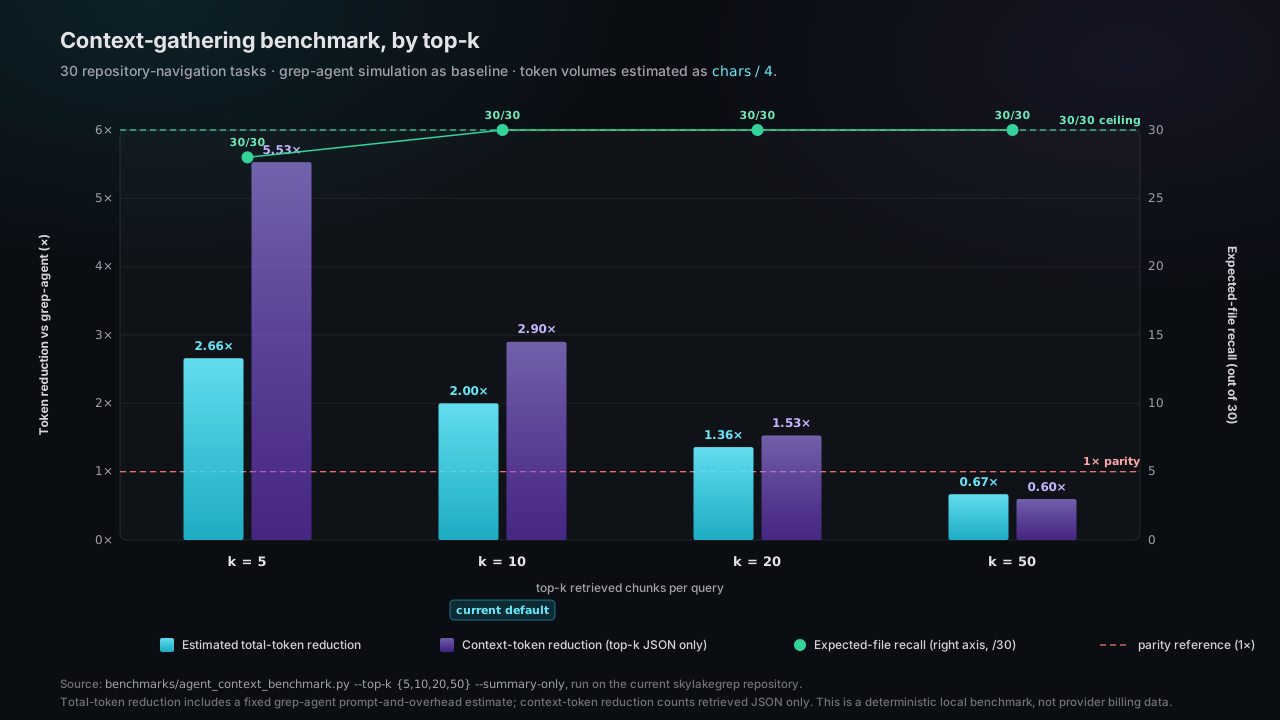
At top-k 10 on the deterministic context-gathering benchmark in this repository:
skygrep hit rate:                       30/30
grep hit rate:                        30/30
estimated total-token reduction:      2.00×
context-token reduction:              2.90×
skygrep tool calls:                      30
grep-agent tool calls:                 227
The result is reproducible from a fresh clone of the matching historical fixture. It is a repository-specific regression receipt, not the current cross-repository headline and not an end-to-end provider billing measurement; see Limitations below.
What is measured
There are two distinct measurements, intentionally kept separate.
1. Retrieval-layer context compression
benchmarks/token_savings.py reports two ratios:
indexed_context_reduction_x      = indexed corpus tokens / retrieved JSON tokens
source_doc_context_reduction_x   = source + docs tokens / retrieved JSON tokens
The numerator approximates the size of context that an agent would otherwise
read; the denominator approximates the size of the top-k JSON snippets
returned by skygrep search. Token volumes are estimated as chars / 4.
This measures how much smaller the retrieved context is than the whole indexed corpus. It does not measure full agent session usage; it does not count planning prompts, tool-call wrappers, repeated searches, follow-up file reads, final answers, or failed attempts.
Run it locally:
OLLAMA_EMBED_MODEL=mxbai-embed-large \
  .venv/bin/python benchmarks/token_savings.py
2. Agent-style context-gathering benchmark
benchmarks/agent_context_benchmark.py runs each task in two conditions:
- Baseline. A grep-agent simulation issues exact-token searches and returns matching line windows, repeated until the expected file is found or a budget is exhausted.
- Treatment. A single
skygrep searchcall retrieves the top-k JSON snippets.
For both conditions the script counts:
- the size of the gathered context, in approximate tokens,
- whether the expected file appears in the gathered context,
- the number of tool calls used.
estimated_total_token_reduction_x adds a fixed grep-agent prompt-and-overhead
estimate to each side and reports the ratio. context_token_reduction_x
reports the ratio of context-only token volumes.
Run it locally:
OLLAMA_EMBED_MODEL=mxbai-embed-large \
  .venv/bin/python benchmarks/agent_context_benchmark.py
Results across top-k
| top-k | recall (skygrep) | recall (grep) | estimated total-token reduction | context-token reduction | notes |
|---|---|---|---|---|---|
| 5 | 28 / 30 | 30 / 30 | 2.66× | 5.53× | Highest token efficiency; misses two expected files. |
| 10 | 30 / 30 | 30 / 30 | 2.00× | 2.90× | Equal recall to grep with the largest token reduction at parity. |
| 20 | 30 / 30 | 30 / 30 | 1.36× | 1.53× | Equal recall, smaller reduction. |
| 50 | 30 / 30 | 30 / 30 | 0.67× | 0.60× | Equal recall, but more tokens than the grep baseline. |
Top-k 10 is the only setting in this table where skylakegrep matches grep-agent recall while keeping the estimated total-token reduction above 1×.
Reproduce a single row with:
.venv/bin/python benchmarks/agent_context_benchmark.py --top-k 10 --summary-only
Limitations
The numbers above support narrow claims only.
- Not provider billing. No real coding agent is executed against a paid model in this benchmark. The total-token figure uses a fixed prompt and overhead model for the grep agent rather than a measured session.
- Not an answer-quality evaluation. Recall is "did the expected file appear in the gathered context", not "is the final synthesized answer correct against a rubric".
- Repository-specific task set. The 30 tasks are tied to this repository's structure and naming. Results on a different codebase may differ and should be measured on an independent task set.
- Embedding model dependency. The embedding model affects retrieval
quality and changes the headline numbers. The numbers above were
measured with
mxbai-embed-large. The current default substrate isbge-m3(1024-d, multilingual, symmetric); re-running this bench onbge-m3is a follow-up. - No cross-encoder rerank. The lexical reranker uses simple token and phrase overlap. A second-stage reranker over a larger candidate pool is on the roadmap and would change the trade-off curve.
Conditions for an end-to-end claim
General Benchmark v2 implements the public pinned-fixture, real-tokenizer,
paired quality-gate, and measured retrieval-latency portions of this plan; see
general-performance.html. It deliberately labels its
scope as retrieval workflow rather than provider end-to-end usage.
A future end-to-end benchmark, suitable for the broader claim that
skylakegrep reduces token usage in real coding-agent sessions, requires
the following:
- A task set of 30–50 questions or navigation tasks with expected files and rubric answers, including easy, medium, and multi-hop items.
- The same model, repository commit, and system prompt across both conditions.
- Per task and per condition, recorded measurements for input tokens, output tokens, tool-call/result tokens, number of tool calls, wall-clock latency, retrieval correctness, and a rubric-graded final answer score.
- Two conditions:
- Baseline. The agent may use exact search tools (
grep,rg), file reads, and shell inspection, but notskylakegrep. - Treatment. The agent may issue one or moreskygrep searchcalls before reading files and may verify with file reads afterwards. - The reported headline metric is
end_to_end_token_reduction = baseline total tokens / treatment total tokens, reported alongside the rubric quality score on each side. A workflow that uses fewer tokens but produces a worse answer is worse, not better.
Until a provider-receipt benchmark is run, this repository does not claim a general end-to-end token or speed multiplier. The historical result above is limited to its deterministic local fixture; General Benchmark v2 separately measures a pinned cross-repository retrieval workflow and publishes a multiplier only after its quality and sample gates pass.