Evaluation · benchmarks
Empirical results across four benchmark dimensions.
skylakegrep ships multiple reproducible benchmark families. Each measures a
different question; quoting the right number for the right claim
matters. The repository's
parity-benchmarks.html
holds the full raw tables, methodology, and per-task data; this
page is the curated summary.
0a. Wrong-path quick-answer (NEW in 0.5.7)
The newest UX gate. Measures how fast the parallel proactive
umbrella streams a first answer when the user is in an
unrelated cwd and the answer lives in a sibling folder.
Setup: cd into an empty directory,
SKYGREP_PROACTIVE_DIRS=/tmp/oss-bench, query
"do I have any package configuration files". The
user runs the real skygrep CLI; we measure
wall clock to first stream block AND wall clock to script
exit.
| Surface | Wall clock | Result |
|---|---|---|
| First stream block (proactive umbrella / cross-folder) | ~1.1 s | 5 cosine-ranked package.json / jest.config.js hits from React + Django repos in SKYGREP_PROACTIVE_DIRS |
| Script exit (full pipeline) | 1.091 s | cascade has nothing to do (cwd empty); umbrella subprocesses delivered directly |
| Same query in 0.5.4 (sequential pre-refactor) | ~12 m 50 s on a code-repo cwd that wasn't the right project | cascade rerank ran 99.7 s on σ-zero query before the proactive answer surfaced |
Concrete output captured in the v0.5.7 release notes
(full notes →): the
streaming markers 🔍 / ▾ / 🌐 / 🌊 / ⚡ arrive
with route + quality labels (filename_extend, ~100 ms-1 s;
pure filename glob, no semantic understanding /
cross-folder lazy, embed budget 5 seeds, σ-validated
 cosine
) so the user can judge the answer's quality
against the route that produced it. Cascade has a 30 s hard
timeout; cross-folder lazy has an 8 s hard timeout.
0b. Cold-start lazy auto-trigger (NEW in 0.5.3)
The newest tier — measures whether the
--lazy auto-trigger that fires on a never-indexed
project actually beats plain ripgrep cold-start on
vocabulary-mismatch queries. Run via
benchmarks/release-0.5.3-rg-vs-lazy.py
— 10 hand-labelled Django queries phrased as natural language
("where is the migration runner that applies pending schema
changes to the database"), every query starts from a freshly
cleaned SQLite DB, and the script invokes the real
skygrep search CLI (not the python API) so the
measured numbers are exactly what a user would see. Compares
--no-lazy (pure rg cold-start) vs default
(auto-trigger).
| Config | hit @ 5 | avg latency | note |
|---|---|---|---|
--no-lazy | 0 / 10 | 4.85 s | pure ripgrep cold-start; vocabulary mismatch finds nothing |
| default (auto-trigger) | 4 / 10 | 20.76 s | LLM-routed dir picker + token-shortcut + import-diffusion |
| delta | +4 / 10 | +15.9 s / query | real, measurable +30 % hit-rate over rg cold-start |
Specific hits: Q1 → django/urls/resolvers.py;
Q3 → migration.py + executor.py;
Q4 → backends.py; Q7 → base.py.
0.5.3 release notes call out the misses (Q2, Q5, Q6, Q8, Q9, Q10
still don't hit because qwen 2.5:3b can't reliably pick the right
dir for some oracle phrasings — tracked as a 0.6 candidate for a
larger router model).
1. End-to-end Claude Code agent
Real Claude Code sub-agents answering hand-labelled code-search questions in two prompted conditions — rg-only (skygrep forbidden) vs skygrep-on (rg/grep/find forbidden) — across 21 questions and 1 multi-turn session in three repos.
| Bench | Tasks | rg-only tools | skygrep tools | Δ tools | Δ tokens |
|---|---|---|---|---|---|
| Multi-turn (3-turn Rust workspace session) | 1 × 3 | 38 | 7 | −82 % | −5 % |
| 6 medium tasks | 6 | 25 | 6 | −76 % | −8 % |
| 14 single-turn ( + ) | 14 | 124 | 87 | −30 % | +12 % |
| 20-task single-turn aggregate | 20 | 149 | 93 | −37.6 % | +6.5 % |
| Strict-label correctness (20 tasks) | — | 12 / 20 | 14 / 20 | +2 tasks | — |
The cleanest, most consistent signal is tool-call reduction: −37.6 % single-turn, −82 % multi-turn. Each agent tool call costs an LLM round-trip + network RTT + serialization + context-window growth, so reducing them shortens the agent loop even when total tokens are equal. Token cost across the 20-task aggregate is roughly flat (+6.5 %); we do not claim skygrep saves the LLM bill.
Best-case task in the original aggregate: a vocabulary-mismatch
question (NL phrasing didn't match any code identifier) — skygrep
finished in 1 tool call vs rg-only's 25 (25× fewer), at one
eighth the wall time. Worst-case: a token-friendly question whose
vocabulary (auth / session / token) overlapped directly with
code-path tokens, so rg's straightforward scan was already
efficient — skygrep was 40 % more tool calls.
The lexical pre-gate addresses this via a
conservative four-condition gate that detects exactly these
queries and short-circuits to rg internally in
~50 ms. Methodology and aggregate published in
the release notes;
see the release notes for the routing fix.
2. Public OSS recall (Django · React · Tokio)
Historical receipt: this section preserves an earlier
three-repository run that used moving repository tips, approximate
chars / 4 token counts, and a deliberately broad term-OR
rg dump. Its 30/30 recall and 60×–770× range are not the current
general-performance claim. The current pinned, quality-gated protocol is
General Benchmark v2.
This table records 30 hand-labelled questions across three popular
open-source codebases under the legacy protocol. The current runner
benchmarks/public_oss_bench.py
now uses exact public pins and emits a new receipt rather than promising
byte-identical reproduction of these historical numbers.
| Repo | Language | LOC ≈ | Tasks | skygrep recall | rg recall | Token reduction |
|---|---|---|---|---|---|---|
django/django | Python | 524 K | 10 | 10 / 10 | 10 / 10 | 703 × |
tokio-rs/tokio | Rust | 80 K | 10 | 10 / 10 | 10 / 10 | 61 × |
facebook/react | JS+TS | 270 K | 10 | 10 / 10 | 10 / 10 | 773 × |
| Aggregate | 3 langs | ~ 870 K | 30 | 30 / 30 (100 %) | 30 / 30 | 60×–770× |
Historical reading: in that run, rg's 100 % was a recall-ceiling
baseline — it returned 20 M+ legacy-estimated tokens of term-OR scan output
per query, so the answer was in the dump but the agent had to read the whole
haystack. Under that historical protocol, skygrep ranked the right
file in the top 10 for 30 / 30 cases while emitting 60×–770× less
estimated context.
React reached 10 / 10 after the Option-C substrate upgrade
(bge-m3 embedder + content-agnostic
non-canonical-path filter); the original failure modes on
react-007 and react-010 and the
resolution are documented in
parity-benchmarks.html
as the engineering record, not erased.
3. Worked example — django-001 (archived calculation)
Historical worked example from one of the 30 tasks aggregated into the public-OSS table above. The values remain visible as the original receipt; rerunning the current pinned protocol produces a new, separately identified measurement.
Query: "Where does Django turn an incoming URL into the view function that should handle it?"
Expected canonical:django/urls/resolvers.py(URLResolver.resolve())
Vocab mismatch: query says "URL into view", code identifier isresolve— the failure mode that grep-as-search collapses on.
Historical side A — rg term-OR scan
The rg-agent extracts up to 8 terms (TF-IDF-ish stopword filter),
runs rg -i -F --max-count=20 -C2 per term,
concatenates output. For this query the extractor produced:
['function', 'incoming', 'incom', 'django', 'handle', 'should', 'into', 'that']
The high-signal words URL, view,
resolve did not survive the extractor — they were
either stopword-filtered or pushed past the 8-term cap. That is
the vocab-mismatch failure: the query's actual intent is
URLResolver.resolve(), but rg searches
for function, django, that
instead.
Archived chars / 4 estimates derived from measured output
volumes per rg invocation:
django1,438,245that841,092function452,938should423,617handle238,008into175,039incom63,593incoming4,024
Under the legacy approximation, django alone is
1.4 million estimated tokens
because the term matches in basically every file of the Django
source tree. that is 840 K estimated tokens
for the same reason — high-frequency words that the stopword
filter let through.
Historical side B — skygrep --top 10 --json
$ skygrep "Where does Django turn an incoming URL into the view function that should handle it?" \
    --json --top 10
$ wc -c   # 10,430 chars ≈ 2,607 tokens
Top files returned include django/urls/resolvers.py
and related canonical implementation files.
Reduction — visual comparison
rg term-OR3,636,556skygrep --top 102,607
The historical 1,395 × estimate is higher than that receipt's
60 × – 770 × range
because vocab-mismatch queries are the worst case for rg
(stopwords flood the output) and the best case for skygrep
(the embedder bridges "URL into view" → resolve()).
Why the historical receipt used a 60 × – 770 × range
rg output scales with
(repo LOC) × (term-frequency of high-signal terms).
skygrep output is ~constant-per-K (top-10 ≈ 10 KB):
| Repo | LOC | Per-query rg tokens (avg) | Per-query skygrep tokens | Ratio |
|---|---|---|---|---|
| Tokio (Rust) | 80 K | ~190 K | ~3.1 K | 61 × |
| Django (Python) | 524 K | ~2.06 M | ~2.9 K | 703 × |
| React (JS+TS) | 270 K | ~2.28 M | ~2.9 K | 773 × |
Tokio is the floor (small repo, focused vocabulary). Django and
React both blow up because django / react
saturate term-OR scans across mid-sized monorepos.
Inspect the legacy calculation (not an exact reproduction)
# rg side — counts bytes from term-OR scan
cd /tmp/oss-bench/django
for term in function incoming incom django handle should into that; do
  rg -i -F --max-count 20 -C 2 "$term" .
done | wc -c

# skygrep side — counts bytes from top-10 JSON
skygrep "Where does Django turn an incoming URL into the view function that should handle it?" \
  --json --top 10 | wc -c

# divide chars by 4 to approximate tokens
The original page did not pin the Django source commit, so a current clone is
not expected to reproduce these values within a fixed tolerance. The commands
illustrate the old chars / 4 calculation only; the current pinned
runner produces a new, versioned receipt with exact tokenization. Per-task
analysis for all 30 historical queries lives in
parity-benchmarks.html.
4. Closed-loop agent benchmark (0.5.14, gated in 0.5.15)
The historical 0.5.14 fixture expanded the agent benchmark from one retrieval call to the full
loop that coding agents actually run: path discovery, evidence gathering,
and sufficiency scoring before the next reasoning step. It does not call
remote Claude, GPT, or any cloud model. Instead it compares two
deterministic local policies: a skygrep-first agent that uses JSON
path-only probes, compact snippet passes, scoped reads, and
--no-rerank first; and a raw rg-only agent that runs
repeated term searches and line-window reads.
The task set covers 38 generic maintenance questions across this repo plus Django, React, and Tokio. The scoring model measures expected-path coverage, path precision, evidence-term coverage, sufficiency, completed tasks, tool-call count, raw retrieval elapsed time, estimated downstream agent elapsed time, and context tokens. Path precision and context volume measure how much irrelevant evidence the next LLM turn has to filter.
| Metric | skygrep-first | raw rg-only | Reading |
|---|---|---|---|
| Tasks | 38 | 38 | self + Django + React + Tokio |
| Path coverage | 94.7 % | 100.0 % | rg remains the recall ceiling |
| Path precision | 10.9 % | 3.4 % | skygrep returns less irrelevant path noise |
| Evidence coverage | 99.1 % | 99.3 % | near-parity evidence coverage |
| Sufficiency score | 96.5 % | 99.7 % | weighted path + evidence score |
| Completed tasks | 35 | 38 | the remaining skygrep misses are explicit follow-ups |
| Tool calls | 322 | 337 | similar call count, much less context per call |
| Raw retrieval elapsed | 154.23 s | 327.73 s | 2.12× lower measured retrieval time |
| Estimated agent elapsed | 161.68 s | 3833.97 s | 23.71× lower after context-read cost |
| Context tokens | 223,592 | 105,187,419 | 470× less context for skygrep |
| Work quality / minute | 12.829 | 0.561 | 22.87× higher closed-loop utility rate |
Historical framing: raw rg remains the recall ceiling, and the
skygrep-first policy still missed three of the 38 tasks that broad
lexical dumping covered. Many public tasks in this 0.5.14 fixture were
path-only and carried no literal evidence terms, while the agent elapsed row
is modeled rather than measured. Keep these numbers as a historical receipt,
not a current general multiplier. General Benchmark v2 uses pinned public
commits, non-empty source evidence, exact tokenization, paired quality gates,
and confidence intervals. Reproduce the legacy receipt with
benchmarks/universal_closed_loop_benchmark.py --repo self --repo django --repo react --repo tokio --summary-only.
In 0.5.15, saved JSON reports can be checked by
benchmarks/closed_loop_regression_gate.py, which fails a release
when skygrep-first falls below configured coverage, sufficiency,
context-reduction, or work-quality-per-minute thresholds.
4b. Hybrid agent-context parity (0.5.17)
0.5.17 re-runs the self repository-maintenance task set against a real
ripgrep agent baseline after promoting bounded rg, path tokens,
symbols, chunk text, source-type priors, and symbol anchors into one
automatic --agent-context recall substrate. The purpose is
narrower than the 0.5.14 closed-loop benchmark: it asks whether the first
machine-readable evidence pass can recover every target that broad ripgrep
finds, while still giving the next LLM much less context to read.
| Metric | real rg agent | skygrep --agent-context | Reading |
|---|---|---|---|
| Tasks | 30 | 30 | generic repo-maintenance queries |
| Hit rate | 30 / 30 | 30 / 30 | equal path-hit recall |
| Context tokens | 6,049,556 | 271,561 | 22.28× less context for skygrep |
| Estimated total tokens | 6,088,556 | 310,561 | 19.61× lower estimated total token load |
| Average hot-query latency | 0.519 s | 0.376 s | steady-state query reuse, not cold indexing |
| Tool calls | 179 | 30 | one skygrep call per task |
| MRR | 0.0078 | 0.7333 | expected files rank much higher for agents |
The release reading is: for this agent-facing self benchmark, skygrep now
reaches the same hit-rate ceiling as real ripgrep while making recall
automatic inside --agent-context. Agents should inspect
agent_summary, why_ranked, and
suggested_followup_probe before manually broadening to raw
rg. Fresh indexing for this run took 192.281 s; the latency row
above reports hot-query reuse after the index exists.
4c. Indexing and closed-loop hardening (0.6.0)
0.6.0 measures the new cross-file embedding batch path against the previous per-file request pattern on the same repository, then reruns the medium closed-loop agent policy after the confidence and benchmark-contract fixes. These numbers are separate receipts: the indexing row measures a fresh build; daemon and doctor rows measure hot operational paths; the closed-loop rows measure eight generic repository tasks.
| Metric | Before | 0.6.0 | Reading |
|---|---|---|---|
| Fresh index elapsed | 624.44 s | 74.71 s | 8.36× faster; about 88% lower elapsed time |
doctor median | heavy import path | 0.216 s | dependency discovery avoids heavyweight import |
| Hot daemon agent-context median | optional reranker on startup path | 0.372 s | server binds before optional background warm-up |
| Medium closed-loop completion | contract contained path-task mismatches | 8 / 8 | 100% path coverage, evidence coverage, and sufficiency |
| Medium work quality | - | 95.7% | no failed tasks in the final run |
Accuracy is not inferred from speed. Regression tests separately cover
deterministic chunk/file ordering, explicit-version authority, stale watch
cleanup, retrieval-only confidence, and answer-source filtering. A live
release-policy answer cited only the current docs/RELEASING.md
anchor after unrelated snapshots and planning notes were removed.
4d. Strict evidence and CI contract gate (0.7.0)
0.7.0 adds a deterministic, model-free six-task fixture that executes the
real hybrid candidate-recall implementation and feeds its report through the
closed-loop regression gate on every pull request. The raw-rg
side models the repeated exact-search calls and returned context an agent
would need for the same evidence contract. This fixture is a stable regression
check, not a universal runtime claim.
| Metric | skygrep-first | modeled raw rg | Reading |
|---|---|---|---|
| Completed tasks | 6 / 6 | 6 / 6 | no completion regression |
| Path / evidence / sufficiency | 100% / 100% / 100% | 100% / 100% / 100% | accuracy gates remain equal |
| Context tokens | 14,689 | 59,551 | 4.05× less context |
| Tool calls | 6 | 99 | one bounded skygrep call per task |
| Estimated agent elapsed | 293.85 s | 1,191.27 s | 4.05× lower modeled elapsed |
| Work quality / minute | 0.2042 | 0.0504 | 4.05× higher |
Separate unit and HTTP integration tests enforce strict fresh/stale behavior, exit-code semantics, direct/daemon Top-K and provenance parity, daemon project-boundary rejection, and macOS path-alias coalescing without lexical score double-counting.
4e. General Benchmark v2
General Benchmark v2 replaces a single headline multiplier with a paired, quality-gated cross-repository protocol. It pins exact commits of Cobra, Django, React, Spring Framework, Tokio, and Vite and evaluates 60 public source-evidence tasks. Every task requires an accepted path plus literal evidence from that source; empty path-only evidence contracts are rejected.
The 2026-08-15 clean-source receipt is reportable. On the
53 / 60 unique tasks where both policies met quality ≥ 0.85,
skygrep-first returned 17.982× less tool context at the
median. The repository-aware 95% hierarchical-bootstrap interval is
5.202×–94.127×. Retrieval-context quality was 92.5% for
skygrep versus 88.4% for rg-only; completion was 180 / 180 versus
159 / 180 observations.
rg-only lets --max-count act per file, so common terms
return most of a large repository (median 13.8M tokens per Spring task). The
ratio therefore measures savings against an unbounded dump, not against an
agent that truncates tool output. 0.8.0 adds the realistic rg-agent
baseline and the token-lean skygrep-slim policy; see
General performance.
| Published metric | Result | Claim boundary |
|---|---|---|
| Eligible-task context reduction | 17.982× median | P25 5.998× · P75 93.141× · 95% CI 5.202×–94.127× |
| Quality gate | 92.5% vs. 88.4% | Deterministic retrieved-context proxy, not final-answer grading |
| Tool calls | 0.929× paired median rg / skygrep | No tool-call reduction claim; skygrep used 2,014 vs. 1,743 overall |
| Measured harness elapsed | 0.561× paired median rg / skygrep | Median eligible skygrep task was slower; no universal speed claim |
| Contract | Requirement | Why it matters |
|---|---|---|
| Quality floor | Both policies ≥ 0.85 and completed | Efficiency cannot hide a worse answer |
| Non-inferiority | skygrep within 2 percentage points of rg | Aggregate accuracy is a hard gate |
| General sample | ≥ 30 unique eligible tasks, ≥ 3 repositories, ≥ 80% eligible observations | Repeated trials cannot inflate task count |
| Benchmark source | One full Git commit, clean tracked worktree, identical across jobs | Mixed or local-WIP receipts cannot become a public claim |
| Token counting | tiktoken cl100k_base | No unlabeled chars-per-token estimate |
| Uncertainty | Repository → task hierarchical bootstrap | One favorable repository cannot dominate the interval |
| Latency | Measured wall and tool elapsed reported separately | No modeled context-reading time presented as speed |
This remains a retrieval-workflow benchmark: context-token counts exclude hidden model reasoning, final-answer output, provider caching, billing, and price. See the full methodology and reproduction commands or inspect the immutable raw receipt. The older 4.05× six-task result remains useful as a deterministic CI regression receipt, not as a general multiplier.
5. Agent bounded-latency smoke matrix (0.5.16)
0.5.16 adds a focused release smoke matrix for the agent timeout contract: scoped path anchors, compact evidence snippets, router-timeout fallback, cascade-timeout fallback, setup-instruction discovery, deep known-file reads, broad implementation lookup, and an absent-concept negative control. The matrix is intentionally local and generic; it uses repository-maintenance questions, not private user paths or document names.
| Case | Shape | Measured result |
|---|---|---|
| T1 | scoped path-only | 1.945 s, 100 % expected-path coverage |
| T2 | scoped evidence | 5.117 s, 100 % coverage |
| T3 | router-timeout evidence | 4.840 s, 100 % coverage |
| T4 | cascade-timeout evidence | 4.805 s, 100 % coverage |
| T5 | setup-instruction discovery | 3.059 s, 100 % coverage |
| T6 | deep known-file read | 4.406 s, 100 % coverage |
| T7 | broad implementation lookup | 4.920 s, 100 % coverage |
| T8 | absent-concept negative control | 4.554 s, correctly returned no evidence |
The intended reading is not "every machine will return in exactly these seconds." It is that agent calls now have an enforced bounded-response policy: useful compact evidence when available, fallback or an honest empty result when evidence is weak, and no unbounded foreground refresh before JSON returns.
6. skylakegrep self-test (regression guard)
Deterministic local benchmark over 30 repository-navigation tasks
against this very repo. Compares a single skygrep search
call against a simulated grep-agent. Token volumes are estimated
as chars / 4. Every release is verified to keep
30 / 30 at top-k 10.
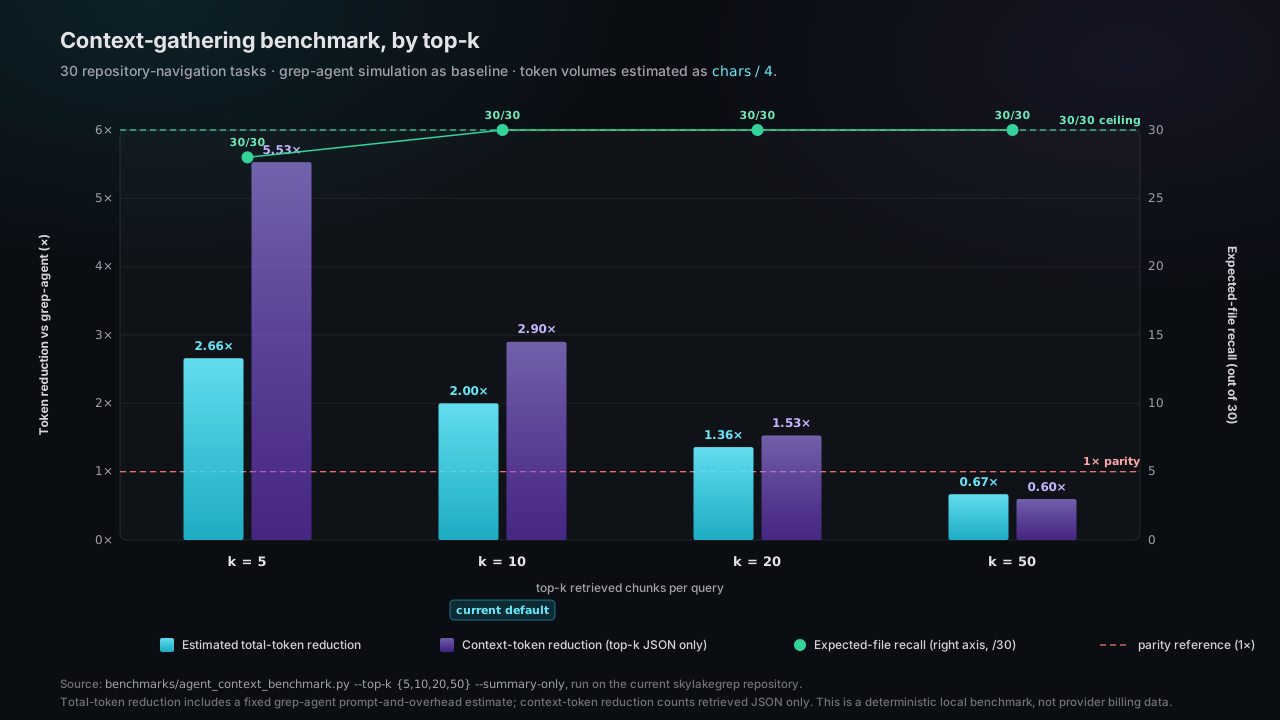
benchmarks/agent_context_benchmark.py --top-k N
command.
| top-k | recall | total-token reduction | context-token reduction |
|---|---|---|---|
| 5 | 28 / 30 | 2.66× | 5.53× |
| 10 | 30 / 30 | 2.00× | 2.90× |
| 20 | 30 / 30 | 1.36× | 1.53× |
| 50 | 30 / 30 | 0.67× | 0.60× |
Vs real ripgrep (not the simulated grep-agent), this same task set shows ~17.7× total-token reduction at equal recall. See the benchmark protocol for definitions and limitations.
How to scope the historical receipts
The examples below are versioned engineering records, not current general performance claims. Cite them only with the named fixture and method. General Benchmark v2 does not publish a multiplier until its quality, sample, source, and confidence gates pass.
- Historical single-turn and multi-turn agent fixtures → benchmark 1: −37.6 % single-turn, −82 % multi-turn (real Claude Code sub-agents, 20 + 1 hand-labelled tasks).
- Historical 0.2 public-OSS parity fixture → benchmark 2: 30 / 30 (100 %) across Django + React + Tokio public OSS, vs rg's 30 / 30 baseline (which emitted 20 M+ legacy-estimated tokens per query).
-
Historical
django-001worked example → benchmark 3:django-001worked example with archivedchars / 4estimates —rg3.6 M tokens vsskygrep2.6 K tokens (≈ 1,395 ×) on a single vocab-mismatch query. - Historical 30-task self-test → benchmark 6: ~17.7× total-token reduction at equal recall on the 30-task self-test.
-
Historical 0.5.17 agent-parity fixture →
benchmark 4b: 30 / 30 vs real
rg, 22.28× less context, 19.61× lower estimated total tokens, 30 tool calls instead of 179, and much higher MRR. - Historical 0.5.16 bounded-latency smoke matrix → benchmark 5: the 0.5.16 smoke matrix covers scoped path, evidence, timeout fallback, deep read, broad lookup, and negative controls.
- "the legacy 0.5.14 fixture reported smaller context and modeled closed-loop utility" → benchmark 4: 470× less context, 23.7× lower modeled agent elapsed, and 22.9× higher modeled work quality per minute. These are historical fixture figures, not a current general claim.
Don't combine these into a single number or detach them from their release
and fixture labels; they answer different questions. The historical protocol is in
parity-benchmarks.html's
archived methodology section, while the current claim contract is
General Benchmark v2.